
There are plenty of model cars you can buy off the shelf. You can find miniature versions of famous Ferraris, Porsches, Lamborghinis and classic racing cars in almost every scale.
But what if the car you want to recreate isn’t a famous supercar?
What if it’s your car?
Maybe it’s the car you’ve spent years modifying. Maybe it’s your first performance car, your weekend project, your daily driver, or a vehicle you’ve owned for a particularly important period of your life.
That is where a custom model car becomes something very different from an ordinary diecast.
Instead of simply collecting a miniature version of a particular model, you are creating a miniature version of your specific car.

Can You Really Make a Model of Your Own Car?
In many cases, yes.
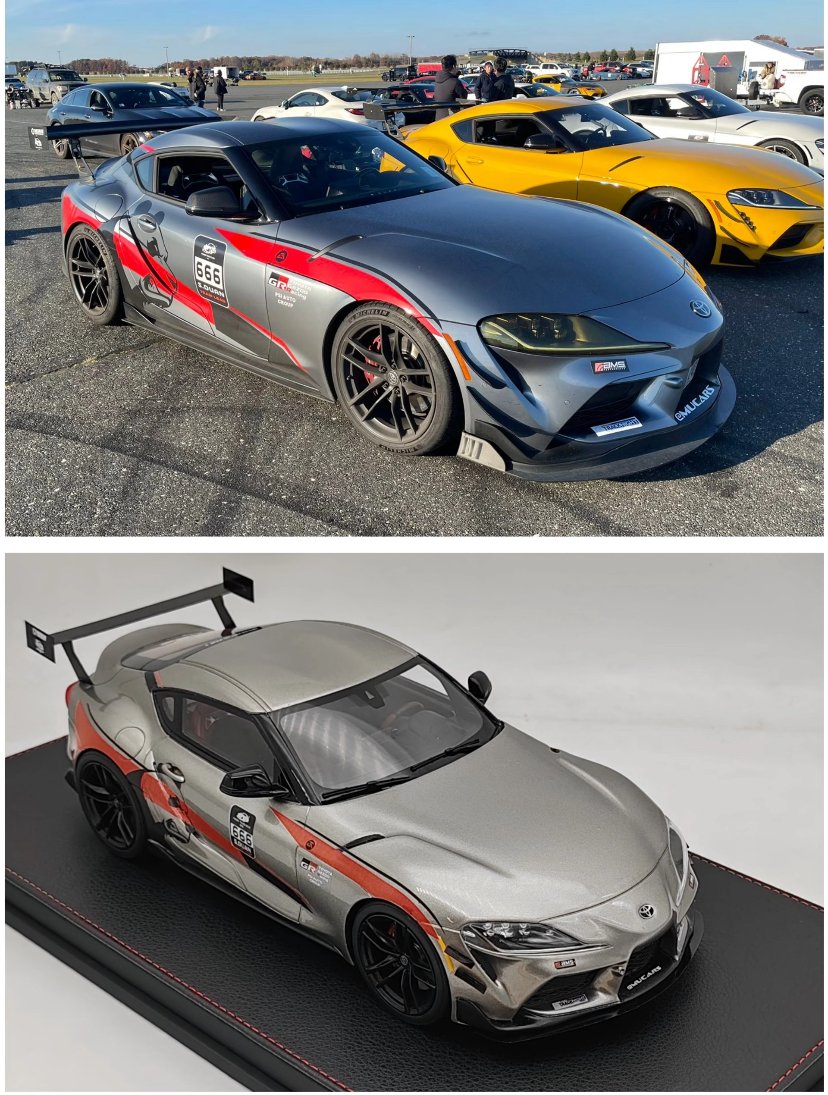
The starting point is usually an existing scale model of the same vehicle, which provides the basic shape and proportions. From there, the model can be modified to reproduce the important characteristics of the customer’s actual car.
The more information available about the original vehicle, the more accurately those details can be reproduced.
This is particularly useful for cars that have been modified from their factory specification.
Two vehicles can have the same make, model and year but look completely different because of their:
- Wheels
- Paint colour
- Body modifications
- Spoilers
- Roof racks
- Exhaust systems
- Decals
- Racing liveries
- Badges
- Lighting
- Licence plates
- Interior details
These are the details that turn a generic model into a personal replica.
What Photos Do You Need?
Good reference photos are one of the most important parts of the process.
Ideally, you should provide clear photographs from several angles, including:
- Front
- Rear
- Left side
- Right side
- Front three-quarter view
- Rear three-quarter view
Additional close-up photographs can also be extremely useful.
For example, if your car has unique wheels, a modified grille, a particular badge or a custom spoiler, a close-up photograph gives the modeller much more information than a distant photograph.
If possible, photographs of the interior, dashboard, steering wheel and other distinctive details can also help.
You don’t necessarily need professional photography.
In fact, ordinary photographs taken with a phone are often perfectly useful as long as the important details are visible.
How Accurate Can a Custom Model Be?
The answer depends on the base model, the scale, the available information and the complexity of the modifications.
A standard diecast model may represent a vehicle accurately enough to identify the make and model.
A custom replica aims to go further.
The goal is to reproduce the characteristics that make your particular vehicle recognisable.
That could mean matching the factory paint colour, reproducing a specific wheel design or adding the same graphics and accessories found on the real vehicle.
For heavily modified cars, the process can become considerably more involved.
A vehicle with a completely different body kit, custom wheels, racing decals and additional components may require significantly more work than a car that only needs a colour change and licence plate.
What Can Be Customised?
There are many possibilities depending on the base model.
Paint
The colour is often one of the first things people notice.
A factory colour can be matched as closely as practical, allowing the miniature to reflect the appearance of the real vehicle rather than simply using the colour of the original diecast.
Wheels and Rims
Wheels can completely change the character of a car.
A custom model may require different rims, wheel finishes or even specially produced wheel components to reproduce the appearance of the original vehicle.
Tyres
For racing and performance cars, even small tyre details can make a noticeable difference.
Sidewall lettering, racing markings and other details can sometimes be reproduced depending on the scale.
Body Graphics and Liveries
This is particularly important for racing cars.
Custom graphics can include:
- Racing liveries
- Sponsor logos
- Stripes
- Numbers
- Personal graphics
- Motorsport markings
High-quality reference artwork can make this process considerably easier.
Licence Plates
A personalised licence plate is a small detail, but it can make the finished model feel much more personal.
For many owners, it is one of the details that immediately confirms:
“That’s my car.”
Custom Components
Some vehicles require components that aren’t available on the original model.
Depending on the project, these may include:
- Spoilers
- Roof racks
- Light bars
- Splitters
- Exhaust components
- Mirrors
- Other modified body parts
These parts may need to be individually produced and fitted to the model.
What Scale Should You Choose?
Scale makes a significant difference to the level of detail that can realistically be achieved.
1:18 is one of the most popular choices for highly detailed custom builds because it provides enough physical space for many modifications and small details.
Smaller scales such as 1:24 and 1:32 can also be suitable for certain projects, but complex graphics and tiny components naturally become more difficult as the model gets smaller.
For extremely small scales such as 1:64, the availability of suitable base models can also become a limiting factor.
For a heavily customised vehicle, choosing the right base model and scale is therefore an important part of the initial assessment.
How Long Does a Custom Model Car Take?
A simple model and a highly detailed replica are two very different projects.
A fully customised, collector-grade model can take several months because the work involves much more than simply changing the colour.
Depending on the project, the process can include:
- Selecting a suitable base model
- Preparing the body
- Precision painting
- Creating custom graphics
- Applying decals
- Producing or modifying wheels
- Creating additional components
- Adding personalised details
- Final assembly
- Quality checking and finishing
For complex commissions, the production process can take around 3–4 months.
The exact timeframe depends heavily on the level of customisation and the availability of the required base model and components.
How Much Does a Custom Model Car Cost?
There is no single price for a one-off custom replica.
A model that only requires a few personalised details will naturally cost less than a heavily modified racing car with a complex livery and numerous custom components.
For a high-detail custom model, pricing typically starts from around **A$1,350**, with more complex builds reaching A$2,500 or considerably more.
The main factors affecting the price include:
- Scale
- Base model
- Paintwork
- Number of decals
- Wheel modifications
- Custom components
- Level of detail
- Production time
The important thing to remember is that a custom model isn’t simply a mass-produced product with a name added to it.
It is essentially a small-scale craft project built around one specific vehicle.
Why Make a Model of Your Own Car?
Perhaps the most interesting question isn’t how to make one, but why.
Your car may not be a limited-production supercar.
It may not ever appear in a museum.
It may not even be particularly valuable on the used-car market.
But that doesn’t necessarily make it unimportant.
A car can represent a first job, a major achievement, a family memory, a motorsport journey, or simply a period of life that you don’t want to forget.
A photograph records what the car looked like.
A custom miniature can preserve something different:
the car itself, in a form you can keep.
And years later, that can become surprisingly meaningful.
Turning Your Car Into a Miniature
Creating a custom model starts with the same thing that made the real car special in the first place: the details.
If you’re considering having your own vehicle recreated, start by gathering clear photographs from different angles and documenting anything unique about the car.
The more information available at the beginning, the easier it is to understand what can realistically be reproduced.
At Mini Car Studio, custom projects are built around the individual vehicle rather than simply the make and model. Each project is assessed based on the available base model, reference material and requested modifications.
Your car doesn’t have to be famous to deserve a miniature.
Sometimes, the cars that mean the most to us are the ones that only matter to us.
If you’re interested in a custom model of your own car, visit Mini Car Studio for more information.
